Cooperative Board Games: 3 Key Innovations in 2026 US Releases
Advertisements
In 2026, Cooperative Board Games Innovations are reaching a tipping point, with US releases introducing three pivotal shifts: sophisticated AI-driven mechanics, dynamic environmental storytelling, and advanced player customization.
This evolution represents a fundamental change in tabletop design, where technology and creative narrative converge to deliver unprecedented immersion.
By focusing on collective reward and strategic depth, these upcoming titles are set to redefine teamwork and solidify cooperative play as a dominant force in the industry.
The Rise of Advanced AI in Cooperative Board Games
One of the most transformative developments in the realm of cooperative board games is the integration of advanced artificial intelligence, moving beyond simple rule-based automation.
This innovation allows for more dynamic and unpredictable adversaries or game systems, creating a truly adaptive challenge for players.
These AI systems leverage complex algorithms, often supported by companion apps, to manage enemy behaviors, quest progression, and even environmental changes in real-time.
The result is a game that feels more alive and responsive, demanding greater strategic flexibility from the players.
The implementation of such sophisticated AI is set to elevate the difficulty and replayability of cooperative board games, ensuring that each playthrough offers unique challenges.
This pushes the boundaries of what tabletop experiences can offer in terms of intelligent opposition.
Dynamic Adversaries and Responsive Game Masters
The era of predictable enemy patterns is drawing to a close, as advanced AI introduces dynamic adversaries that learn and adapt to player strategies.
This creates a far more engaging and less exploitable opponent, demanding constant reassessment from the cooperative team.
Beyond just combat, AI can now act as a responsive game master, adjusting scenarios, triggering events, and even altering victory conditions based on player performance and choices.
This provides an unprecedented level of narrative flexibility and emergent gameplay, making each session distinct.
- AI-driven enemy tactics that evolve with player actions.
- Procedural generation of challenges and narrative branches.
- Real-time adjustments to game difficulty and objectives.
Companion Apps and Integrated Digital Components
The power of advanced AI in cooperative board games is often unlocked through sophisticated companion applications that handle complex calculations and decision-making processes.
These apps seamlessly integrate with physical components, enhancing the overall gameplay experience without detracting from the tabletop feel.
These digital components can track player statistics, manage intricate game states, and even provide voice-acted narrative elements, deepening immersion.
The blend of physical and digital elements represents a hybrid approach that capitalizes on the strengths of both mediums.
This integration ensures that players spend less time managing rules and more time engaging with the core gameplay and strategic decisions.
The efficiency provided by these apps streamlines the cooperative experience, allowing for richer, more complex scenarios to unfold.
Immersive Narrative Design and Branching Storylines
The second major innovation impacting cooperative board games is a significant leap in immersive narrative design, offering players truly branching storylines and impactful choices.
This moves beyond static scenarios to narratives that genuinely react to player decisions, shaping the game’s direction.
Games are increasingly incorporating elements common in role-playing games, such as character development, morally ambiguous choices, and persistent world states that reflect previous sessions.
This creates a deeper emotional connection to the game’s unfolding story.
This focus on narrative depth ensures that the cooperative experience is not just about winning or losing, but about the journey and the collective story players create together. It transforms each game into a unique, memorable saga.

Player Agency and Consequential Choices
Modern cooperative board games are empowering players with unprecedented agency, where choices made during gameplay have tangible and lasting consequences on the narrative.
This goes beyond simple win/loss conditions, impacting future scenarios, character arcs, and even the game’s ending.
This approach encourages deeper discussion and strategic planning among players, as they collectively weigh the ethical and practical implications of their decisions.
The narrative becomes a direct reflection of the group’s collaborative efforts and failures.
- Choices that permanently alter game components or rules.
- Moral dilemmas with no clear-cut ‘best’ outcome.
- Narrative branches that lead to vastly different campaigns.
Campaign Legacy Systems and Persistent Worlds
A significant trend within cooperative board games is the adoption of campaign legacy systems, where the game itself evolves and changes permanently over multiple sessions.
This includes physically altering game components, unlocking new content, and developing a persistent world state.
This innovation fosters a sense of progression and consequence, as player actions in one session directly influence the setup and challenges of the next. The game becomes a living, breathing entity that remembers the players’ journey.
The persistent world aspect encourages long-term engagement and provides a compelling reason for groups to commit to extended campaigns. This creates a truly epic scope for cooperative storytelling.
Enhanced Customization and Modular Game Systems
The third key innovation in cooperative board games focuses on vastly enhanced customization and highly modular game systems, offering players unparalleled freedom to tailor their gaming experience.
This moves beyond simple character choices to fundamental alterations of game rules and content.
These systems allow players to adjust difficulty, introduce new modules, or even design their own scenarios, ensuring the game remains fresh and challenging for years. The emphasis is on player-driven content and adaptability.
This level of customization caters to diverse player preferences and encourages creative engagement with the game’s core mechanics. It transforms games from fixed experiences into flexible platforms for collaborative adventure.
Player-Driven Content and Scenario Creation
A growing number of cooperative board games are now providing robust tools for players to create and share their own content, from custom scenarios and quests to new characters and items.
This community-driven approach significantly extends the lifespan and variety of the game.
These tools often come in the form of accessible rule-sets, modular components, and even online platforms for sharing creations. This fosters a vibrant community around the game, where players become active contributors to its ongoing evolution.
- Official support for fan-made scenarios and expansions.
- Modular rule-sets that allow for easy modification.
- Online repositories for sharing custom content.
Adaptive Difficulty and Scalable Challenges
Cooperative board games are increasingly incorporating adaptive difficulty systems that allow players to fine-tune the challenge to their group’s skill level and preferences.
This ensures the game remains engaging for both new players and seasoned veterans.
These systems can involve scaling enemy strength, adjusting resource availability, or introducing optional modules that increase complexity. The goal is to provide a perfectly balanced experience that is neither too easy nor too frustrating.
This flexibility is crucial for groups with varying levels of experience, ensuring everyone can enjoy the cooperative challenge. It enhances accessibility and replayability, making the game appealing to a broader audience.
Impact on Player Engagement and Replayability
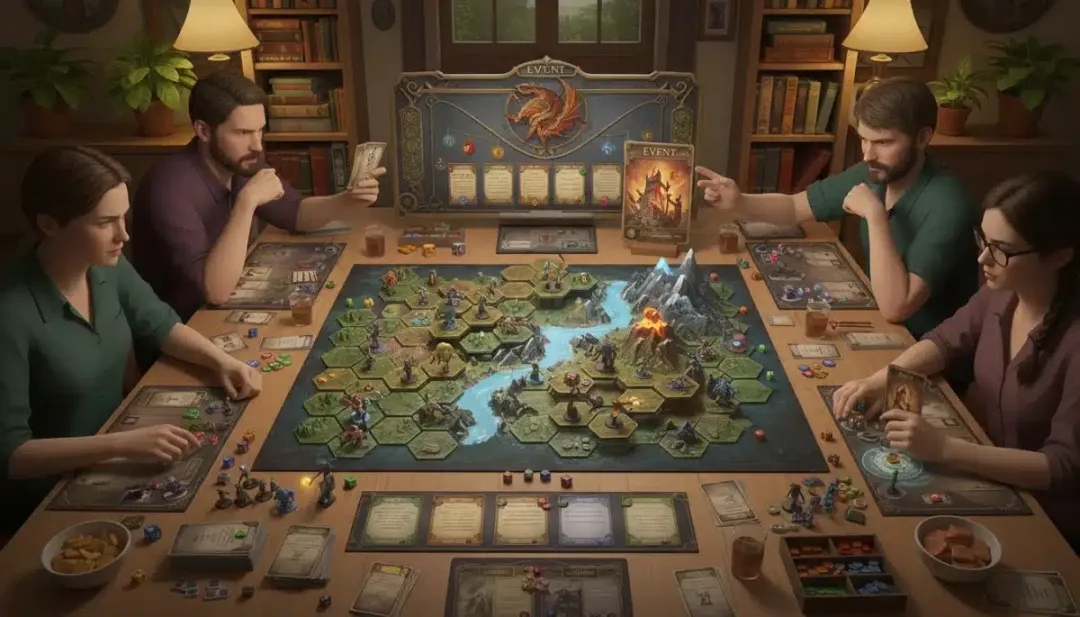
The collective impact of these Cooperative Board Games Innovations on player engagement and replayability cannot be overstated.
Advanced AI ensures dynamic challenges, while immersive narratives provide compelling reasons to return to the game world.
Customization options mean that the game can continually evolve with the players’ preferences, preventing stagnation and offering endless new possibilities.
This ensures that the investment in a cooperative board game yields significant long-term enjoyment.
These innovations collectively create a gaming experience that is not only deeper and more strategic but also more personal and memorable. Players are no longer just playing a game; they are living a shared adventure.
Fostering Deeper Collaboration and Communication
The increased complexity and dynamic nature introduced by these innovations necessitate deeper collaboration and communication among players.
Success often hinges on effective teamwork, strategic discussion, and a shared understanding of the game’s evolving state.
Games are designed to actively encourage dialogue, planning, and collective problem-solving, making the social aspect of cooperative play even more central. This strengthens the bonds within gaming groups and enhances the overall experience.
- Scenarios that demand complex, coordinated actions.
- Communication challenges embedded within game mechanics.
- Rewards for effective team strategy and shared decision-making.
Expanding the Definition of Tabletop Gaming
These advancements are actively expanding the very definition of what tabletop gaming can be, blurring the lines between traditional board games, role-playing games, and even digital experiences.
The cooperative genre is at the forefront of this evolution.
The integration of technology, rich storytelling, and player-driven content pushes the boundaries of interactive entertainment. This signifies a maturation of the medium, offering experiences previously thought impossible on a tabletop.
The future of cooperative board games promises a rich tapestry of experiences that are as diverse as they are engaging, continually surprising and delighting players with new forms of collaborative play.
These Cooperative Board Games Innovations are truly exciting.
Anticipated 2026 US Releases and Early Previews
As 2026 approaches, several publishers have begun to tease upcoming US releases that embody these key Cooperative Board Games Innovations.
Early previews suggest a strong focus on titles that leverage advanced AI, deep narrative choices, and extensive modularity.
Industry insiders report that these games are not just building on existing foundations but are actively pioneering new mechanics and design philosophies.
The anticipation within the tabletop community is palpable, with many eager to experience these next-generation titles.
These early glimpses indicate a vibrant and innovative year for cooperative board games, setting a new benchmark for quality and player experience.
The market is poised for a significant influx of groundbreaking titles.
Spotlight on Promising Titles
While specific titles are still largely under wraps, whispers from game development studios point to several projects that are pushing the envelope.
These games are expected to showcase groundbreaking applications of AI, particularly in how non-player elements react to player input.
Another area of intense focus is narrative depth, with games promising multiple campaign paths and player choices that genuinely shape the game world.
This represents a move towards even more dynamic storytelling in cooperative board games, offering unparalleled replayability.
- Games featuring adaptive AI that learns from player strategies.
- Titles with deeply branching narrative campaigns and persistent world states.
- Highly modular systems allowing players to customize nearly every aspect of the game.
Publisher Strategies and Market Trends
Publishers are clearly investing heavily in these innovative areas, recognizing the growing demand for more sophisticated and engaging cooperative experiences.
The market trend indicates a shift towards games that offer long-term engagement and a strong sense of player agency.
Many companies are also exploring crowdfunding platforms to gauge interest and secure funding for these ambitious projects, often involving extensive digital integration.
This allows for direct feedback from the community and helps refine the game during development.
The competitive landscape is driving designers to innovate, ensuring that the cooperative board game genre remains fresh and exciting.
These strategic moves by publishers are critical for the continued evolution of cooperative board games.
Challenges and Opportunities for Game Designers
While the Cooperative Board Games Innovations present immense opportunities, they also bring significant challenges for game designers.
Balancing complex AI with intuitive gameplay, crafting branching narratives, and designing truly modular systems requires substantial expertise and resources.
Designers must navigate the delicate balance between technological integration and maintaining the tactile, social experience inherent to board gaming.
The goal is to enhance, not overshadow, the physical interaction around the table.
Despite these hurdles, the potential for creating truly groundbreaking cooperative experiences is motivating designers to push creative and technical boundaries.
The rewards for successful innovation are substantial, both for players and the industry.
Balancing Complexity with Accessibility
A primary challenge for designers is ensuring that the increased complexity introduced by advanced AI and modular systems does not alienate new players. The goal is to offer depth without creating an overwhelming learning curve.
This often involves intuitive user interfaces for companion apps, clear rule explanations, and gradual introductions of new mechanics. Accessibility is key to broadening the appeal of these innovative cooperative board games.
- Streamlined digital interfaces for AI management.
- Well-structured tutorials and progressive rule introductions.
- Scalable difficulty settings to accommodate different player skill levels.
Future-Proofing Game Systems
Designing game systems that can adapt to future technological advancements and player expectations is another critical challenge.
This involves creating frameworks that are flexible enough to incorporate new modules, updates, and even entirely new mechanics over time.
The concept of ‘living games’ is becoming more prevalent, where developers continue to support and expand their titles post-release with digital updates or physical expansions. This prolongs the game’s relevance and value for players.
This forward-thinking approach ensures that today’s innovative cooperative board games remain engaging and cutting-edge for years to come. It’s about designing for longevity in a rapidly evolving market.
The Player Experience: What to Expect
For players, the Cooperative Board Games Innovations of 2026 promise an unprecedented level of engagement and immersion.
Expect games that feel more intelligent, narratives that are genuinely reactive, and experiences that are uniquely tailored to your group’s preferences.
These advancements mean that every session will likely offer new surprises, strategic puzzles, and memorable moments of collective triumph or challenge. The predictability of older cooperative titles will be a thing of the past.
Ultimately, players can look forward to a richer, more dynamic, and deeply satisfying cooperative gaming landscape. The future of cooperative board games is bright, offering endless opportunities for shared adventure.
Deeper Immersion and Narrative Agency
Players will find themselves more deeply immersed in game worlds, with narratives that feel personal and consequential.
The ability to shape the story through collective decisions will foster a stronger emotional connection to the game’s unfolding events.
This heightened narrative agency transforms players from passive participants into active protagonists, making each campaign a unique story told by the group. The sense of ownership over the narrative will be a defining feature.
- Narratives that react dynamically to player choices.
- Characters and worlds that evolve based on campaign progress.
- Increased opportunities for role-playing within the cooperative framework.
Unparalleled Replayability and Customization
The innovations in modularity and player-driven content will translate directly into unparalleled replayability. Games will offer a vast array of scenarios, challenges, and ways to play, ensuring that no two sessions are exactly alike.
The ability to customize difficulty, introduce new modules, or even create entirely new content will keep games fresh for years. This empowers players to continually redefine their cooperative experience.
This focus on personalization means that players can tailor games to their specific preferences, ensuring maximum enjoyment and longevity from their investment in cooperative board games.
| Innovation | Description |
|---|---|
| Advanced AI | Dynamic adversaries and responsive game masters, often via companion apps. |
| Immersive Narrative | Branching storylines, player agency, and persistent campaign legacy systems. |
| Enhanced Customization | Modular game systems, player-driven content, and adaptive difficulty. |
| Player Experience | Deeper immersion, unparalleled replayability, and stronger collaboration. |
Frequently Asked Questions About Cooperative Board Games Innovations
What are the primary innovations in cooperative board games for 2026 US releases?▼The primary innovations include advanced AI-driven mechanics, deeply immersive narrative designs with branching storylines, and significantly enhanced customization through modular game systems. These elements are set to revolutionize how cooperative games are played and experienced by players.
How does advanced AI impact cooperative gameplay?▼Advanced AI introduces dynamic and adaptive adversaries, making challenges less predictable and requiring more flexible strategies. It can also act as a responsive game master, adjusting scenarios and objectives in real-time, greatly increasing replayability and strategic depth for cooperative board games.
Will cooperative board games with branching narratives require companion apps?▼While not all will, many games leveraging complex branching narratives and persistent campaign systems will likely utilize companion apps. These apps efficiently manage intricate story paths, player choices, and world state changes, enhancing immersion and reducing physical component clutter in cooperative board games.
What does ‘enhanced customization’ mean for players?▼Enhanced customization means players can tailor their experience through modular game systems, adaptive difficulty settings, and even player-driven content creation. This allows for personalized gameplay, ensuring the game remains fresh and challenging for diverse groups and preferences in cooperative board games.
How will these innovations affect the replayability of cooperative board games?▼These innovations will dramatically boost replayability. Advanced AI ensures varied challenges, branching narratives offer multiple story paths, and customization allows endless configurations. This means each playthrough of cooperative board games can feel unique and engaging, extending the game’s lifespan significantly.
Looking Ahead: The Future of Cooperative Board Games
The Cooperative Board Games Innovations discussed represent a pivotal moment for the tabletop industry, signaling a future where games are more intelligent, more story-driven, and more adaptable than ever before.
These advancements will undoubtedly set new standards for player expectations and design possibilities, ensuring the genre continues its robust growth.
As designers embrace these new paradigms, the cooperative board game landscape will become increasingly rich and diverse, offering experiences that cater to a wider array of tastes and preferences.
The collaborative spirit of these games, amplified by innovation, promises a compelling future. Players should anticipate a wave of exciting new titles that redefine what is possible on the tabletop.
If you are looking for inspiration or want to explore the vast library of titles that paved the way for this era, check out Jason’s Big Geeklist of Played Cooperative Games.